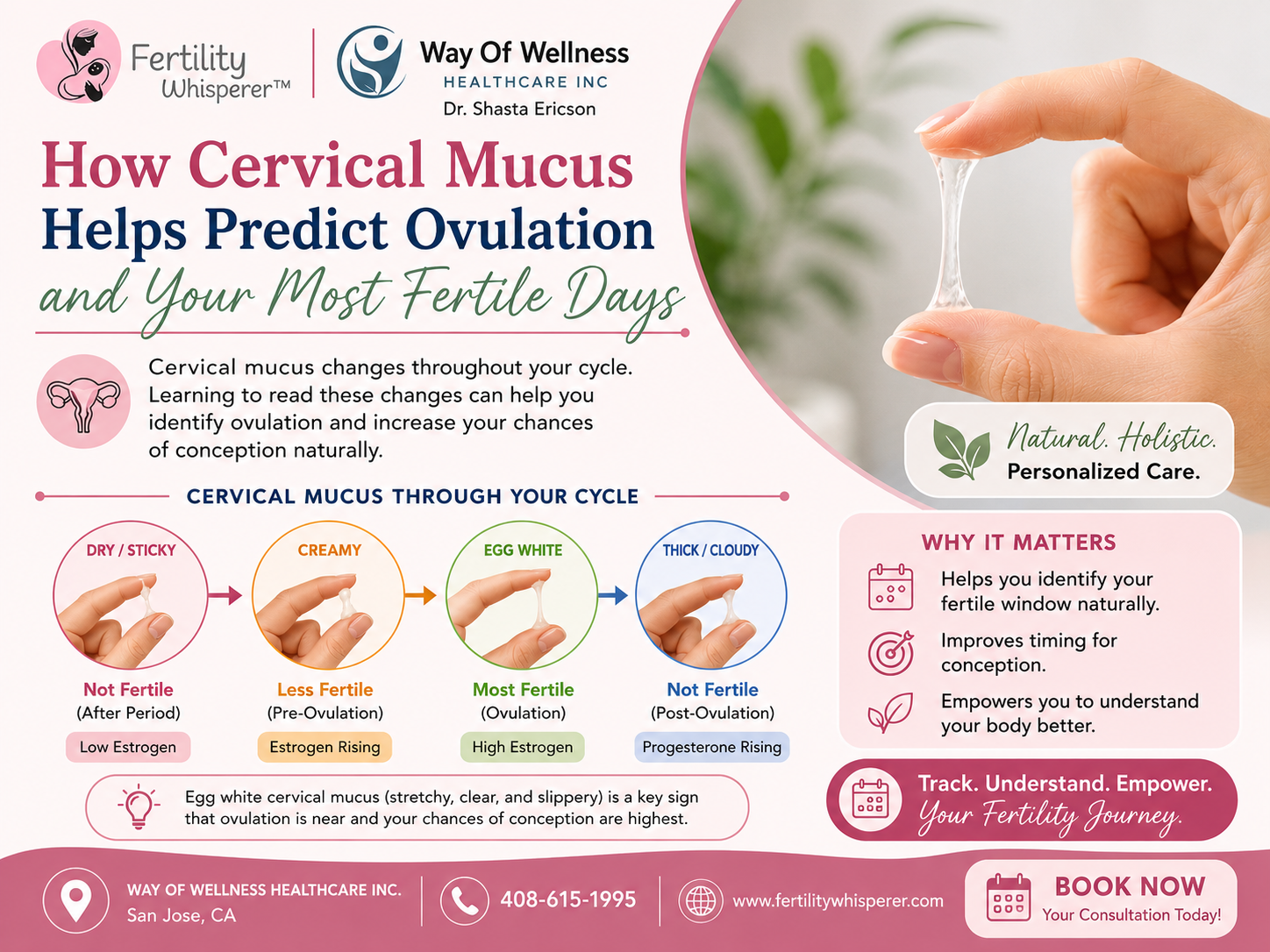
Egg-white-like cervical mucus is among the best natural indicators of your body being on track for ovulation. The stretchable type of discharge normally occurs a couple of days before ovulation and serves to make it easier for sperms to reach the egg. Cervical mucus observation can be an important indicator of one’s fertile period, especially with advice from a fertility expert.
What Is Cervical Mucus and Why Is It Important for Fertility?
Cervical mucus is a secretion of glands located in the cervix that appears throughout the menstrual cycle. The consistency of the mucus depends on hormonal changes and, specifically, estrogen levels. The following description is a result of natural physiological processes.
At the beginning of the cycle, increased estrogen production results in cervical mucus becoming slippery and more watery. This kind of mucus helps keep sperms alive in the female body and facilitates their passage to the fallopian tubes.
If fertility days are approaching, the mucus becomes thicker or absent. This kind of mucus plays the role of a barrier and prevents the passage of sperm.
When using natural methods of conception, this information can be helpful to determine the most suitable periods for sexual contact.
Understanding Egg White Cervical Mucus
Egg White Cervical Mucus (EWCM) is regarded as one of the best signs of the body that ovulation is imminent. This can be deduced from the definition, which is usually clear and slippery like raw egg white.
The characteristics of the egg white cervical mucus are:
- Transparent or slightly opaque
- Slippery in nature
- It has stretchable consistency; it stretches up to several centimeters between fingers.
- Wet feeling near the vaginal entrance
This type of mucus is commonly produced when estrogen levels are at their peak before ovulation. It ensures the creation of the best path for sperm to thrive.
Patients undergoing fertility treatments who monitor their menstrual cycles report noticing egg white cervical mucus for one or more days before ovulation. But everyone’s menstrual cycle varies, so some might get this mucus for five days while others might get it for one day.
How Long After Egg White Cervical Mucus Do You Ovulate?
One of the frequently asked questions by couples hoping to get pregnant is: “How soon after egg white cervical mucus do you ovulate?“
Ovulation usually occurs within 24-48 hours following the peak day of egg white cervical mucus. The peak day is considered the day of the highest quality of mucus when it is very stretchable and slippery.
It is important to remember that the presence of EWCM is the indication of impending ovulation, but not the accurate ovulation marker.
| Fertility Sign | What It Usually Indicates | Typical Timing |
| Increased watery mucus | Estrogen is rising | Several days before ovulation |
| Egg white cervical mucus appears | The fertile window is beginning | Usually 1–5 days before ovulation |
| Peak EWCM day | Highest fertility signs | Often close to ovulation |
| Mucus becomes thicker or decreases | The fertile window may be ending | After ovulation |
For improved accuracy, many fertility specialists suggest using cervical mucus tracking in combination with other methods, such as ovulation predictor kits, basal body temperature charting, or ultrasound examinations.
How Can You Use Cervical Mucus To Help Find Your Fertile Window?
A fertile window is the window of time when conception is possible. Due to the ability of sperm cells to stay alive inside the woman’s reproductive tract for some time, intercourse prior to ovulation might lead to conception.
Practical Example:
Day 10: Cervical mucus becomes wet
Day 12: Egg white cervical mucus appears
Day 13: Peak day
Day 14: Possible ovulation
In this case, the most fertile days can be the two days before ovulation and the day of ovulation itself.
Observing the process during several menstrual cycles will help you understand your individual pattern rather than relying on cycle calculations alone.
Patient-Like Real Example: How To Track The Changes In Cervical Mucus Properly
People start to track changes in cervical mucus after many months of trying to conceive without knowing their fertile period.
For instance, a woman with the regular 28-day cycle may think that she always ovulates on day 14. After observing the cervical mucus changes, she finds out that the egg white cervical mucus appears on day 11 and disappears on day 13.
However, at Fertility Whisperer™, fertility management revolves around the concept of understanding an individual’s unique reproductive cycle rather than adopting the one-size-fits-all method. Conducting an evaluation can reveal what is behind your conception difficulty – whether it is timing, hormones, egg quality, sperm health or any other factor.
Egg White Cervical Mucus – Tips for Monitoring It Properly
In case you wish to monitor your egg white cervical mucus as one of the ways of fertility awareness, these tips will come in handy to you:
Check Consistently Daily
Check how your mucus looks every day. Preferably, do this daily before going to the bathroom or right after washing your hands.
Record your observations
Use some fertility app or a calendar and record the following:
- First day when you see watery mucus
- When egg white cervical mucus appears
- The day when it reaches its peak
- What happens after suspected ovulation
After monitoring for two to three months, it usually becomes easier to spot the pattern.
Pay attention to the other signs of fertility
- Cervical mucus is just one of the fertility signs, and others may include
- Pelvic discomfort around ovulation
- Sexual desire
- Changes in basal body temperature post-ovulation
4. Seek Professional Help if Necessary
The cervical mucus test can be effective, but it cannot diagnose fertility issues. It is advisable to see a specialist when you have tried conceiving for a long time or suffer from irregular cycles, painful menstruation, and known reproductive conditions.
Cases When Egg White Cervical Mucus May Not Be Present
Though it is not easy to identify the egg white cervical mucus, this may not necessarily mean that you are not ovulating.
There could be many possible cases where the absence of egg white cervical mucus could happen, such as:
- Hormone imbalances
- Medications
- Breastfeeding
- Age
- Dehydration
- Stress
- Certain fertility issues
In case there is any confusion about mucus and conception, one may seek fertility experts’ advice at fertility clinics.
Author Bio
Dr. Shasta Ericson, Fertility Specialist
Dr. Shasta Ericson is a fertility specialist dedicated to helping individuals and couples understand their reproductive health and explore personalized fertility solutions. With experience in fertility evaluation and treatment planning, Dr. Ericson combines medical expertise with a patient-focused approach to provide clear guidance throughout the fertility journey. Through Fertility Whisperer™, she focuses on education, evidence-based care, and realistic fertility support tailored to each patient’s needs.
How Do Fertility Specialists Help You Understand Your Cycles?
Fertility specialists do not just consider individual symptoms but assess the whole fertility landscape. This could be in terms of the menstrual history, ovulation patterns, hormone tests, ultrasound results, and even things to do with the partner.
Dr. Shasta Ericson offers specialized advice for fertility issues at Fertility Whisperer™ in fertility evaluation and reproductive health care, emphasizing the need for an evidence-based approach to treatment plans in fertility care. Dr. Ericson also makes sure that the patients are offered realistic expectations along with a compassionate approach to fertility treatments.
Frequently Asked Questions
1. Is egg white cervical mucus an indication of ovulation?
The egg white cervical mucus is normally an indication that ovulation is imminent. This type of cervical mucus is common in the days before ovulation when estrogen levels are high. This type of cervical mucus does not indicate ovulation.
2. How many days after egg white cervical mucus do you ovulate?
Most people ovulate between 24 and 48 hours after the peak day of egg white cervical mucus.
3. Can I conceive without egg white cervical mucus?
Yes. There are some women who never experience cervical mucus but ovulate and conceive. There are other methods used to track fertility status and conception.
4. When should I visit a fertility clinic?
Visiting a fertility clinic becomes necessary when there is difficulty conceiving, irregularity in the menstrual period, and repeated miscarriages.
5. Does more cervical mucus indicate greater fertility?
No. The quality of the cervical mucus is important rather than the quantity. Egg white mucus is normally the best for conception.
Leave a Reply